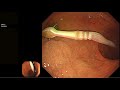
A 16 year old female with a history of personality disorder, deliberate self harm, overdose and swallowing of foreign bodies was admitted for a third time in a month having swallowed a toothbrush and then complaining of abdominal pain. Xrays showed that the toothbrush was in the stomach. The video shows the extraction of the toothbrush under conscious sedation…
—
The toothbrush is a rather unusual foreign body to be found in the gastrointestinal tract. In a report, a MEDLINE search of the years 1988 to 2000 found 11 articles with approximately 40 cases of toothbrush ingestion [1]. Almost all of the patients were female, ranging from 15 to 23 years of age [2,3]. Most of the patients had been diagnosed with psychiatric problems such as bulimia or anorexia nervosa. A person with an eating disorder may use the handle of the toothbrush to induce vomiting. A clue to this diagnosis is a toothbrush ingested with the handle distally and the bristles proximally [1,3,4]. This orientation was seen in our patient.
Toothbrushes have a characteristic appearance on radiographs: small metallic densities arranged in parallel rows. These metallic densities represent the metallic plates that hold the bristles in place [3]. At endoscopy, toothbrushes have been found in the oesophagus, stomach, and duodenum where they are easily identified [1,5]. Unlike most other ingested foreign bodies, spontaneous passage of a swallowed toothbrush does not usually occur [3] because of the object’s relatively large size. Prompt removal from the gastrointestinal tract is therefore advised to minimise complications such as impaction (which usually occurs in the pylorus or the second part of the duodenum), gastritis, ulceration, and perforation and subsequent peritonitis [3,4].
One case reported of a case of a swallowed toothbrush found in the ascending colon that caused a fistula between the right colon and the liver, with a complicating small hepatic abscess [6].
In 1983, the first case of successful endoscopic toothbrush removal was reported [7]. Other cases have reported failure of endoscopic removal due to the size or shape of the toothbrush [8,9]. In addition, cases of oesophageal perforation during endoscopic toothbrush extraction[10] and of laparoscopic-assisted toothbrush extraction via gastrostomy after an unsuccessful attempt at endoscopic removal[9] have been reported. Consequently, endoscopic retrieval is the recommended treatment. However, surgical removal is sometimes required due to the geometric qualities of the toothbrush.
REFERENCES
1.Faust J, Schreiner O. A swallowed toothbrush. Lancet. 2001;357:1012.
2. Kirk AD, Bowers BA, Moylan JA, Meyers WC. Toothbrush swallowing. Arch Surg. 1988;123:382–384.
3.Riddlesberger MM, Jr, Cohen HL, Glick PL. The swallowed toothbrush: a radiographic clue of bulimia. Pediatr Radiol. 1991;21:262–264.
4.Wilcox DT, Karamanoukian HL, Glick PL. Toothbrush ingestion by bulimics may require laparotomy. J Pediatr Surg. 1994;29(12):1596.
5. Sachdeva OP, Gulati SP, Kakker V, Sachdeva A, Mishra DS, Sekhon MS. Unusual foreign body in the duodenum. Indian J Gasteroenterol. 1994; 13(1):33.
6.Kim IH, Kim HC, Koh KH, et al. Journey of a swallowed toothbrush to the colon. Korean J Intern Med. 2007;22(2):106-108. doi:10.3904/kjim.2007.22.2.106
7.Ertan A, Kedia SM, Agrawal NM, Akdamar K. Endoscopic removal of a toothbrush. Gastrointest Endosc. 1983;29:144–145.
8.Wilcox DT, Karamanoukian HL, Glick PL. Toothbrush ingestion by bulimics may require laparotomy. J Pediatr Surg. 1994;29:1596.
9.Wishner JD, Rogers AM. Laparoscopic removal of a swallowed toothbrush. Surg Endosc. 1997;11:472–473.
10.Selivanov V, Sheldon GF, Cello JP, Crass RA. Management of foreign ingestion. Ann Surg. 1984;199:187–191.