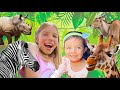
Diana and sisters are visiting Safari. Learning Wild Animals.
There are some most impressive South Africa animals!
Firstly, there are the ‘Big Five’: elephant, buffalo, leopard, lion and the rhino.
The term ‘Big Five’ is used to describe the power and strength of the animals. The term was coined last century as these five animals were the most difficult to be hunted on foot.
Wildlife in South Africa is abundant, with almost 300 mammal species.
There are several animal species that are among the world’s tallest, fastest or even tiniest animals such as the majestic giraffe, the speedy cheetah or the tiny pygmy shrew.
Several animal species are endangered such as the African wild dogs, the oribi or the rhino which is hunted for its horn. Many wild animals are kept and protected in national parks or private game reserves. Conservation efforts in South Africa have been successful in growing populations of the mountain zebra and bontebok, an antelope species that only exists in South Africa.
Mammals include humans and all other animals that are warm-blooded vertebrates (vertebrates have backbones) with hair. They feed their young with milk and have a more well-developed brain than other types of animals.
Black Rhinoceros
Black rhinoceroses have a sort of attack-first-and-ask-questions-later attitude. When a rhino catches the scent of a human or anything else unfamiliar, it is likely to charge. Rhinos can't see well, so they sometimes charge objects like trees and rocks, mistaking them as threats. But rhinos have keen senses of smell and hearing.
Rhinos sometimes fight with each other. Black rhinos use the bigger of the two horns on their noses as weapons in a fight.
Their horns, made of a substance similar to that of human fingernails, sometimes break off, but they regenerate, or grow back. Female rhinos also use their horns to protect their babies from predators such as lions, crocodiles, and hyenas.
Giraffe
Giraffes grow about 4 feet (1.2 meters) in their first year of life. A newborn giraffe is about 6 feet (1.9 meters) tall at birth and weighs about 150 pounds (68 kilograms).
Many young giraffes, called calves, die from lion attacks during their first year of life. Once a giraffe reaches adulthood its height is often enough to protect it from lions. Adult giraffes, however, must still be careful of lions when they are bending down to drink water or rest. Usually giraffes will drink or rest in shifts so that at least one giraffe is always on the lookout for approaching predators.
The giraffes' height and excellent vision give them a wide view of the grasslands where they live, making it easy to spot predators from a distance. Some scientists believe that other animals—such as zebras, antelope, and wildebeests—often congregate near giraffes to take advantage of their ability to see danger from a distance. The giraffe could be considered the early warning system of the African grasslands.
Zebra
Each zebra has its own unique pattern of distinctive stripes, just as humans have their own unique pattern of fingerprints.
Zebras stick together in herds. Within a herd, zebras tend to stay together in smaller family groups. Families are generally made up of a male, several females, and their young.
As a zebra grazes, it uses its sharper front teeth to bite the grass, and then uses its duller back teeth to crush and grind. A zebra's teeth keep growing for its entire life, because constant grazing and chewing wears them down.
#kidsvideos #LadyDidisis #wildanimals #zebra #Giraffe #safariforkids
#kidsvideos #LadyDidisis