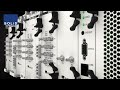
The SOLiD ALLIANCE 5G DAS headend is modular, scalable, space-saving, and works with every power class of ALLIANCE remote. https://solid.com/us/products/alliance-das/
[email protected] https://www.linkedin.com/company/solid-technologies
How's the 5G Mobile Coverage in Your Building?
https://youtu.be/r9pDsKEwr1I
Transcript:
SOLiD ALLIANCE 5G DAS, solves the cellular connectivity problems in your building and enables customers, tenants, and employees to use their 5G mobile devices.
There are several reasons why the coverage in your building is poor. Check the video link below that explains the common causes.
A DAS begins with headend equipment that serves as the demarcation point for the wireless service providers to connect their networks. These signal sources provide dedicated capacity for the people in your building.
The central element of the ALLIANCE headend is the integrated BTS interface unit - or iBIU.
The iBIU aggregates and sends cellular signals over fiber optic cables to remote units at various locations in the building.
The iBIU works with all SOLiD ALLIANCE remote units including low power Fiber2Antenna models as well as medium and high power Fiber2Coax models. The remotes provide radio signals that communicate with mobile devices.
The iBIU is modular and fits in a standard 19 telco rack occupying only four rack units.
Modularity enables you to grow the system as needed. It also protects your investment from obsolescence. Add a new frequency band, such as CBRS, or transition from one technology to another, like 4G to 5G, with simple, cost-effective modular upgrades.
Insert up to four iMDBU cards in the iBIU. Each iMDBU supports one or two cellular frequency bands. These cards provide filtering, leveling, and power control.
On the back of the iBIU, POI cards interface with the iMDBUs. Each of the POI’s support up to 4 services from the mobile networks. The POI’s condition the radio frequency signals to appropriate levels for conversion to optical signals. Because they integrate with the iBIU, they significantly reduce the total amount of headend rack space versus other solutions. The POI’s are available in high power, low power, and hybrid high & low power models.
Up to sixteen mobile network services may connect to the iBIU using either duplex or simplex cabling.
The iBIU may be configured as a main or secondary unit. Use an iMCDU to configure the iBIU as the main unit. Use an iSCDU to configure an iBIU as the secondary unit. A main and secondary iBIU may be connected to double the available ports for very high-capacity systems.
The iMCPU controls and monitors the system’s status.
The eMPSU provides DC power to the iBIU and is available in versions that use AC and DC input power.
Up to two optical modules fit in the iBIU. Each card supports either one or four optical connections to DAS remotes.
For large systems, expanded optical port capacity is available. Up to three iODUs may connect to the main iBIU providing up to an additional 24 optical ports.
The DAS Management System (DMS) is the alarming, diagnostic, and control interface providing network intelligence for comprehensive DAS management of up to twenty iBIUs.
The SOLiD ALLIANCE 5G DAS headend is modular, scalable, space-saving, and works with every power class of ALLIANCE remote.