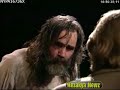
This nearly 20-minute, unedited archival tape captures the raw camera feed of ABC’s Diane Sawyer interviewing Charles Manson at Corcoran State Prison in 1993.
The footage strips away the polished editing of network television to reveal the grueling, manipulative reality of interviewing a sociopath.
Sawyer repeatedly attempts to corner Manson into admitting direct responsibility for the Tate-LaBianca murders ("Did you tell them to do their witchy things?", "Did you tell them to mutilate?").
Manson responds with an aggressive, highly calculated word salad.
He deflects blame entirely, claiming he was merely retrieving a brother from jail and that the followers acted of their own accord.
He weaponizes political and historical rhetoric to justify his existence, comparing his "rights" to a 1776 revolution and dismissing the brutality of his crimes by pointing to the massive body counts of World War II and global starvation.
The archive reaches its most jarring, surreal climax in the final two minutes:
The interview ends, the tension completely dissipates, and Manson casually poses for smiling souvenir photographs with Sawyer and the television crew.
Sociological Analysis:
This uncut footage is a devastating sociological autopsy of the American "true crime" industrial complex. Manson is not engaging in a genuine conversation; he is performing the exact "Crazy Charlie" persona that the media has paid for and the public expects.
He explicitly calls out this dynamic, telling the crew, "All the guys you've been creating are not really real in real life."
He understands that his identity is a media construct, and he plays the role perfectly to maintain relevance and power from inside a concrete cell.
Manson’s rhetorical strategy relies on false equivalencies and the hijacking of systemic grievances.
When pressed on the slaughter of a pregnant Sharon Tate, he immediately deflects to the "poor people starving to death over the Appalachians" and the casualties of WWII.
By doing this, he attempts to neutralize his localized, personal evil by drowning it in the macro-level atrocities of the state.
He divides reality into the "underworld" and the "over world," positioning himself as a victim of a society that offers no recourse for the poor ("When you get in trouble you go to your mother... I ain't got no mother to call").
It is a masterclass in narcissistic deflection.
However, the most sociologically damning moment of the entire archive is the concluding photo op.
After twenty minutes of discussing butchery, race wars, and mutilation, the cameras stop rolling, and the network journalists happily arrange themselves around a mass murderer to take smiling polaroids.
This sequence completely shatters the illusion of journalistic moral superiority. It proves that within the American media machine, notoriety and celebrity are absolutely indistinguishable.
The monster is ultimately treated not as a pariah, but as an A-list attraction.
Key Archival & Sociological Moments:
[00:03:57] – The Hijacking of Patriotism:
Manson uses the American Revolution as a defense, claiming that if the system denies him his rights, he becomes "King George." It demonstrates how extremists bastardize foundational historical narratives to legitimize their violence.
[00:08:29] – The Class Divide:
"You guys live in the over world, I live in the underworld."
Manson astutely identifies the socio-economic disconnect between the polished television crew and the brutal reality of the penal system he has inhabited for 45 years.
[00:13:23] – The Sociopathic Deflection:
When Sawyer brings up the horrific details of the murders, Manson immediately attempts to shame her for ignoring global poverty and wartime atrocities, an aggressive tactic to invert the moral high ground.
[00:17:56] – The Celebrity Photo Op:
The interview concludes, and the network crew poses for souvenir photographs with Manson. This unfiltered moment exposes the grim reality of the media ecosystem: a serial killer is ultimately treated as a high-status celebrity.
Video Specifications:
Date: 1993
Subject: Charles Manson / Diane Sawyer / True Crime Media Sociology / Corcoran State Prison / Sociopathy
Source: Hezakya Newz & Films Archives
Format: Digitized Raw News Broadcast & Uncut Interview Feed
Duration: 19:52
This film documents:
The unvarnished, manipulative reality behind polished network television interviews with notorious criminals.
Charles Manson's specific psychological tactics of deflection, false equivalence, and media manipulation.
The grotesque commodification of violence, evidenced by journalists taking smiling souvenir photos with a convicted mass murderer.
#CharlesManson #1993Archive #TrueCrimeHistory #Sociology #DianeSawyer #HezakyaNewzAndFilms #RawArchive #MediaCritique #TheMansonFamily #UnvarnishedHistory