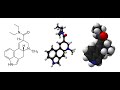
This is an audio version of the Wikipedia Article:
Lysergic acid diethylamide
Listening is a more natural way of learning, when compared to reading. Written
language only began at around 3200 BC, but spoken language has existed long ago.
Learning by listening is a great way to:
- increases imagination and understanding
- improves your listening skills
- improves your own spoken accent
- learn while on the move
- reduce eye strain
Now learn the vast amount of general knowledge available on Wikipedia through
audio (audio article). You could even learn subconsciously by playing the audio
while you are sleeping! If you are planning to listen a lot, you could try using
a bone conduction headphone, or a standard speaker instead of an earphone.
You can find other Wikipedia audio articles too at:
https://www.youtube.com/channel/UCuKfABj2eGyjH3ntPxp4YeQ
In case you don't find one that you were looking for, put a comment.
This video uses Google TTS en-US-Standard-D voice.
SUMMARY
=======
Lysergic acid diethylamide (LSD), also known as acid, is a hallucinogenic drug. Effects typically include altered thoughts, feelings, and awareness of one's surroundings. Many users see or hear things that do not exist. Dilated pupils, increased blood pressure, and increased body temperature are typical. Effects typically begin within half an hour and can last for up to 12 hours. It is used mainly as a recreational drug and for spiritual reasons.While LSD does not appear to be addictive, tolerance with use of increasing doses may occur. Adverse psychiatric reactions such as anxiety, paranoia, and delusions are possible. Long term flashbacks may occur despite no further use. Death as a result of LSD is very rare, though occasionally occurs via accidents. The effects of LSD are believed to occur as a result of alterations in the serotonin system. As little as 20 micrograms can produce an effect. In pure form LSD is clear or white in color, has no smell, and is crystalline. It breaks down with exposure to ultraviolet light.In the United States, as of 2017, about 10% of people have used LSD at some point in their life, while 0.7% have used it in the last year. It was most popular in the 1960s to 1980s. LSD is typically either swallowed or held under the tongue. It is most often sold on blotter paper and less commonly as tablets or in gelatin squares. There are no known treatments for addiction, if it occurs.LSD was first made by Albert Hofmann in 1938 from lysergic acid, a chemical from the fungus ergot. Hofmann discovered its hallucinogenic properties in 1943. In the 1950s, the Central Intelligence Agency (CIA) believed the drug might be useful for mind control so tested it on people, some without their knowledge, in a program called MKUltra. LSD was sold as a medication for research purposes under the trade-name Delysid in the 1950s and 1960s. It was listed as a schedule 1 controlled substance by the United Nations in 1971. It currently has no approved medical use. In Europe, as of 2011, the typical cost of a dose was between 4.50 and 25 Euro.