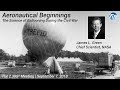
Lecture Starts at 18:10
Joseph Henry was the first director of the Smithsonian Institution and the founder and first president of PSW. He was one of the most important American scientists of his time, and widely regarded as the most important since Ben Franklin. Henry was fascinated by weather and weather prediction, and he had an early appreciation of the potential of aeronautics for studying the atmosphere, and for understanding the weather. The balloon was then becoming a platform for scientific investigation, allowing atmospheric measurements up to an altitude of 30,000 feet. Another passion of Henry’s was studying electricity and magnetism, and his pioneering work on electrical induction led to the invention of the telegraph, in which he played a direct role. The unit of induction today is named the Henry, in his honor, in recognition of his work in this area.
These two interests came together dramatically at the start of the Civil War. Under Henry’s guidance aeronaut Thaddeus Lowe distinguished himself on the National Mall by sending a telegram to President Lincoln from an altitude of 500 feet, reporting the clear view he had of Virginia and of the Confederate lines of defense some miles away. The ability to see the disposition of the Confederate forces from afar demonstrated in a compelling way the potential military uses of balloon observations, and Henry and Lowe worked together to convince Lincoln that a balloon could contribute to the Union Army’s efforts to gather actionable intelligence. They were successful, and at President Lincoln’s insistence, the Union Army established a Balloon Corps, appointing Lowe its Chief Aeronaut.
Once operational, the Balloon Corps grew to seven specially constructed government balloons, 12 portable hydrogen gas generators, and a first of its kind flat-top aircraft carrier, requiring Lowe to hire many aeronauts. As a visible alarm system, Lincoln’s Air Force calmed public fears of Confederate troops invading Washington. It was the nation’s first Air Force. Lowe’s Balloon Corps eventually flew more than 3,000 times, and was in the air during many battles in 1862 and 1863. It was disbanded, despite its successes, just before the battle of Gettysburg.
James L. Green is the Chief Scientist at NASA. Previously, he was Director of the Planetary Science Division at NASA. During his tenure he oversaw many seminal missions, recently including the landing of the Curiosity rover on Mars and the flyby of Pluto and its moons by the New Horizons spacecraft. Before that he was Chief of the Space Science Data Operations Office, Head of National Space Science Data Center, and Deputy Project Scientist on the IMAGE mission. He has been at NASA since 1980.
In addition to his long involvement with NASA, Jim has had a passionate interest in the history of the Civil War and ballooning in particular. He has conducted research on Civil War balloons and ballooning for more than 25 years. He often speaks on the subject, and he has worked with the Civil War Trust to identify balloon stations used in the Peninsula Campaign to ensure their preservation.
Jim has written over 100 scientific articles on the Earth’s and Jupiter’s magnetospheres, and over 50 technical articles on data systems and networks. Among numerous awards and honors, Jim received the Flemming award for outstanding individual performance in the Federal government, Japan’s Kotani Prize, and the NASA Exceptional Achievement Medal for the New Horizons flyby of Pluto.
Jim earned his PhD in Space Physics at the University of Iowa.