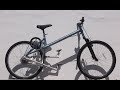
The latest upgrade of this bicycle can be seen at: https://www.youtube.com/watch?v=5-2eK1HsDcA What sets the High Torque Cruiser (HTC17) apart from prior art is its reciprocal system for pivoting member lever machines, which is an improvement to a propulsion system utilizing free wheel sprocket(s), roller chains and crank sprocket(s) assemblies. This particular design has mechanical properties that prior art does not have. These properties include a metal housing 34 with the ability to pivot seperate pulley wheels back and forth; a stopping means that prevent a lever machine from pivoting up, therefore preventing its adjacent lever machine from hitting the ground; a shock absorbant means which absorbs the impact of the lever machine against the aluminum housing 34; and a positioning of the each pivotal pulley wheels that allows the steel cable that rolls over it, to interact with member lever machines at a 90 angle, which prevent each lever machine from being pulled right or left and as a result would keep each lever machine frictionless and in parallel alignment. The reciprocal system mentioned offers four main elemental benefits:
1. It reduces friction
2. It reduces weight
3. It keeps right and left lever machines in parallel alignment.
4. It serves as a stopping means for each lever machine.
An improved lever propelled bicycle that provides the rider with the means of low pedaling resistance due to no rotation of the pedal, thus voiding out the fluctuation in force needed to pedal the bicycle forward. A pedal on a conventional bicycle changes its position in proximity to the fulcrum of the crank sprocket as it rotates. The lever enhance pedaling systems with elevated crank sprockets maintains a linear curve, thus reducing the fluctuation in effort needed to propel the bicycle. The vertical spring around the reciprocal cable on the opposite side of the pressed pedal contracts, while absorbing the shock of the downward pedal when it is pressed to its lowest pivotal point, then gives energy back to the leg, while causing it to bounce up to reposition or raise the foot upward for future downward pedaling. This repetition of downward pedaling and energy return would happen on both pedals as each pedal reciprocate in opposite directions up and down. The propulsion chain is positioned midway on the lever machine between the fulcrum and pedal. However, this chain position is located closer to the fulcrum giving the rider more mechanized leverage. So if the rider pedals the bicycle when it is a single speed or the internal gear hub ratio is 1 to 1, the rider’s downward weight on the pedal should give an output of over twice the rider’s weight. Furthermore, an internal multispeed hub within the rear wheel would allow the rider to increase his or her speed simply by changing the gear ratio at the right handle bar grip.
Additionally, the bicycle is lighter than its predecessor because much of the frame’s tubular diameter has been reduced, which includes the middle tube and rear tube. The middle tube diameter had been reduced from 2.50” to 2”. The rear symmetrical tubes diameter has been reduced from 1.25” to 1.00”. The lever machines have significantly less aluminum plate forms surrounding the bore, which complements the fulcrum of the lever machines. Instead of four pulley wheels for the reciprocal system, this bicycle now has two. The advantage of this bicycle is that it has its right and left freewheel sprockets directly below the seat of the bicycle, instead of on opposite sides of the rear wheel hub. This means it can accommodate a more efficient multi-speed hub like the Nuvinci n360 internal speed hub for a wide range of multi-speed gear ratios. Furthermore, it can accommodate more traditional multispeed freewheel flywheel cassette sprockets with a derailleur system. Derailleur systems cost less than internal multispeed hubs and can allow the cost of the bicycle to do down significantly.
The freewheel sprockets fixed at opposite ends of the rational axle that is between the outer surface of the rear wheel and seat can be configured to be small, while the fixed middle sprocket that rotates in one direction between the freestyle sprockets can be configured to be larger in pitch diameter in order to move the drive chain connected to the rear wheel a longer distance. This middle sprocket would have a conventional chain connecting it to the freestyle sprocket coupled to the rear wheel of the bicycle. This freestyle sprocket would be smaller in pitch diameter than the central sprocket as the freestyle sprockets located between the seat and rear wheel. Carbon fiber belts could be used with the central sprocket and rear wheel sprocket to reduce the weight of the bicycle.
In conclusion the beneficial elements of the Lever Enhanced Pedaling System with Elevated Crank Sprockets are that:
The load is closer to the fulcrum than to the pedal or area of applied force, which allows the peddler’s efforts to be doubled or