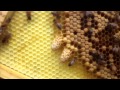
Again, not a malady or pest per se, but an issue that needs discussion. If I leave all these queen cells it can lead to disastrous swarming when they all start hatching. Instead I selected only a handful, 3-4, that looked the biggest and best to leave behind, and the rest I sabotaged, plucking them off the comb to remove them from the hive.
I found these right after I had put together 8 mating nucs with cages queen cells. I could have moved some of these on the frame instead into the queenless nucs. But if I had done that I would have removed a bunch of very important brood from this colony. I suppose I could have then swapped in capped brood from other colonies to bridge the gap. That's yet another beauty of having multiple hives, the ability to aid weaker colonies with the stronger ones.
It might take brood 21 days to develop, but it only takes a good queen a day or two to fully lay a frame. I suppose I could use one hive for just brood boosting to other colonies, but ideally ALL colonies will have good strong queens that are laying a lot of eggs!
People always ask what a queen cell looks like, and I say "you'll know when you see one, trust me!" Not to be confused with a queen cell "cup", these are capped queen cells. Cups just look like a larger, overdrawn cell, and is the base to a potential queen cell. Just because you see cups doesn't mean the bees are raising a new queen.